
Global trade is often interpreted through the lens of power projection — fleets, sanctions, and territorial control.
This interpretation is incomplete.
The true structure of global trade stability does not emerge from military dominance alone.
It emerges from shared adherence to rules that make movement predictable, insurable, and scalable.
This is where the current geopolitical tension becomes strategically meaningful.
The Misunderstanding of Power at Sea
Power at sea is not simply the ability to control a location.
It is the ability to guarantee that movement through that location remains trusted by all participants.
A chokepoint without trust becomes a liability.
A chokepoint governed by law becomes infrastructure.
This distinction separates actors that extract value from those that enable systems.
The Role of Maritime Law in System Stability
The United Nations Convention on the Law of the Sea (UNCLOS) is often framed as a legal framework.
In reality, it functions as a coordination protocol for global trade flows.
Its primary role is not ownership.
It is predictability.
Predictability enables:
- insurance underwriting
- long-term contracts
- route planning
- capital allocation
Without it, flows do not stop — but they become volatile, expensive, and structurally fragile.
Chokepoints: Where Theory Meets Reality
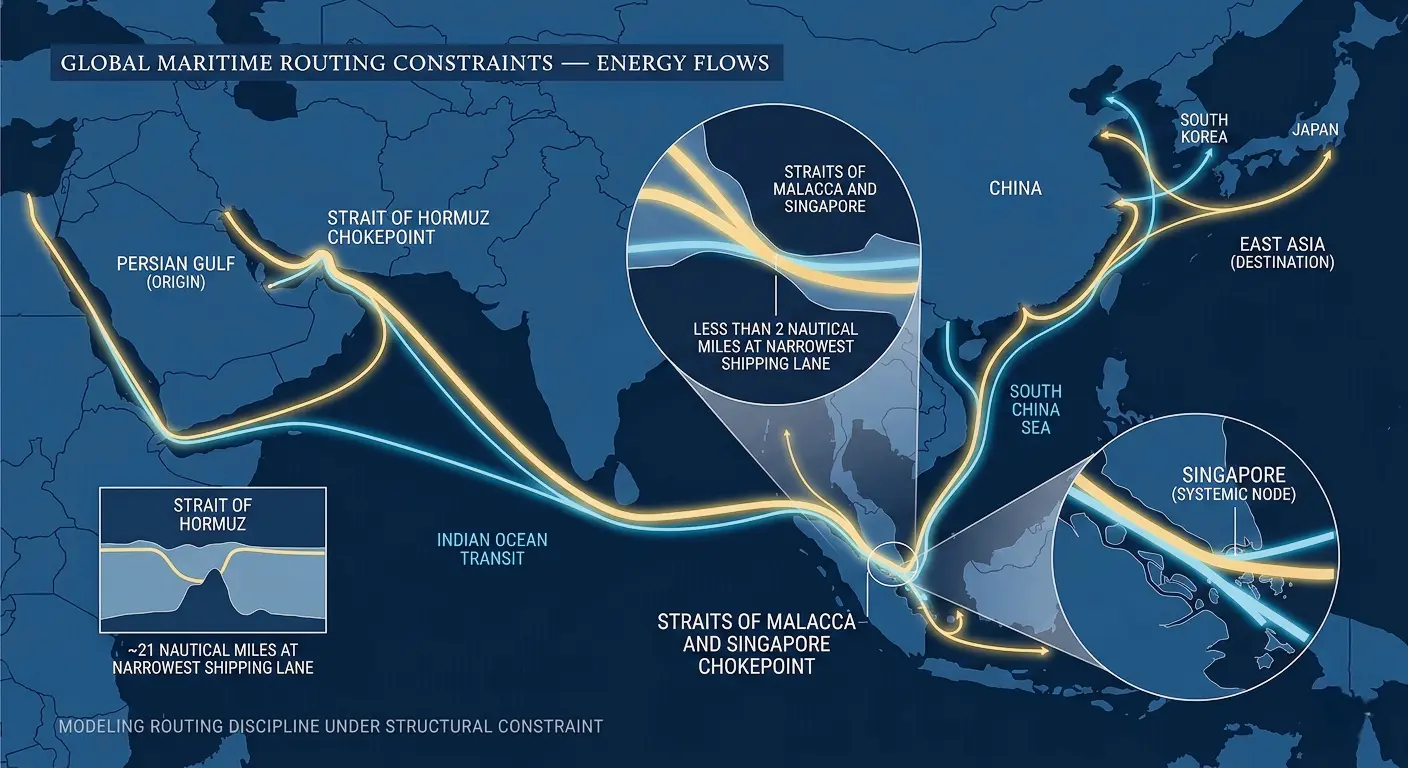
Global maritime routing constraints highlighting the strategic role of chokepoints such as Hormuz and the Straits of Malacca and Singapore.
Consider two critical maritime passages:
- The Strait of Hormuz (~21 nautical miles at its narrowest shipping lane)
- The Straits of Malacca and Singapore (less than 2 nautical miles at their narrowest point)
Both are structurally narrow.
Both carry disproportionate global energy flows.
Yet they are not perceived equally.
The difference is not geography.
It is behavior under constraint.
On 7 April 2026, Singapore’s Foreign Minister Vivian Balakrishnan gave this principle explicit state form in Parliament.
Responding to the idea of negotiating safe passage through the Strait of Hormuz, he rejected the premise entirely: transit through international straits is a right, not a negotiable privilege. He grounded this position in UNCLOS, emphasizing that states bordering such straits must not impede transit passage.
He then made the comparison unavoidable.
While the Strait of Hormuz spans approximately 21 nautical miles at its narrowest, the Straits of Malacca and Singapore narrow to less than two nautical miles in certain sections — yet Singapore has never treated this constraint as leverage.
The implication was structural, not rhetorical.
Constraint does not create power.
Discipline under constraint does.
Constraint as a Signal
When a state operates within constraints — even when it has the capacity to exploit its position — it signals reliability.
When it violates or reinterprets those constraints, it signals optionality.
Markets do not price ideology.
They price uncertainty.
This is why:
- minor disruptions trigger major price volatility
- perceived instability travels faster than actual disruption
- insurance premiums react before flows are physically affected
Singapore: Power Without Extraction
Singapore represents a different model of power.
It does not control production.
It does not dominate through force.
It dominates through flow coordination.
Its strategic role is based on:
- maintaining uninterrupted routing
- ensuring neutrality of passage
- reinforcing legal predictability
- concentrating logistical density
This creates a structural paradox:
The most powerful nodes in global trade are often those that do not extract value directly, but make extraction possible elsewhere.
The Real Risk to Global Trade
The primary risk is not conflict alone.
It is the erosion of shared rules governing movement.
If maritime norms become negotiable:
- chokepoints become bargaining instruments
- routes become political variables
- insurance becomes restrictive
- capital retreats
Trade does not collapse immediately.
It degrades structurally.
A System-Level Conclusion
Global trade is not secured by force alone.
It is stabilized by collective discipline around movement.
States that understand this:
→ become coordinators
→ attract flows
→ accumulate long-term strategic power
States that reject it:
→ generate volatility
→ increase systemic friction
→ weaken their own position in global networks
The future of global trade will not be decided by who controls the sea.
It will be decided by who keeps it usable.
System Context
This article belongs to a wider conceptual system:
- Maritime Chokepoint → structural constraint within global movement
- Flow Coordination → operational discipline that preserves continuity
- Trade Flow → the logic of movement across routes and nodes
- Singapore → a real-world model of rule-based routing power
Together, these elements explain how trade stability depends not only on geography, but on disciplined systems of movement.